Word of the President 2026

A European Renaissance: Recovering Our Soul to Rebuild the Future

Europe must rediscover its soul.

At first glance, this phrase may seem abstract. It is not.

We are living in an age of fractures. Wars are reshaping global balances. Societies are becoming
polarized. Citizens are anxious. Many feel disoriented, exhausted by a world that appears to have lost
its moral center of gravity.

And yet, never has the world needed Europe more.

Not merely its economic strength.
Not merely its institutions.
But what it represents when it is faithful to itself.

When one stands in Scy-Chazelles before the statues of Robert Schuman, Alcide De Gasperi, Konrad
Adenauer and Jean Monnet, one understands something essential: modern Europe was not born
from a market. It was born from a wound.

These men had witnessed war. They had seen the moral collapse of a continent. Their project was not
merely technical. It was ethical. They sought to transform the memory of conflict into an architecture
of peace. They understood that lasting prosperity could not be built upon permanent rivalry. They
made a civilizational choice: to place human dignity above revenge, cooperation above domination.

Today, our crisis is not merely institutional. It is deeper. We speak of competitiveness, energy security,
technological sovereignty, and we are right to do so. But what troubles our societies is not only
material instability. It is the loss of meaning.

We have perfected mechanisms.
But we have weakened purpose.

We have strengthened treaties.
But we have allowed the narrative to erode.

A civilization does not endure through management alone. It endures through vision. It endures
through an idea of the human person.

The real question today is not simply: What kind of Europe do we want?
It is: What conception of the human being do we wish to defend?

A European Renaissance would not mean a nostalgic return to the past. It would mean a deepening.
The first Renaissance rediscovered the human being. Post-war Europe rediscovered peace. The
Renaissance of the 21st century must rediscover conscience.

It must reconcile economy and ethics. It must prove that competitiveness can remain humane. It
must show that advanced technology can strengthen dignity rather than erode it. It must
demonstrate that cultural and religious diversity is not a threat, but a richness, provided it is
structured by shared values.

The world is watching Europe. Not because it is the most powerful, but because it can become the
most balanced. In a polarized world, it can embody democratic maturity. In a fragmented world, it
can embody cooperation. In an anxious world, it can embody responsibility.

But this requires a resurgence. Not merely political, but interior.

Europe will never be reduced to Brussels. It lives in our schools, in our universities, in our companies,
in our associations, in our cities. It lives each time an entrepreneur chooses ethics over immediate
profit. Each time an educator transmits dignity instead of fear. Each time a leader chooses long-term
responsibility over short-term advantage.

A Renaissance will not begin with a decree. It will begin with a convinced minority. It will begin with
consciences that refuse cynicism. It will begin with economic, cultural, and educational actors who
understand that prosperity without soul cannot endure.

We do not need growth alone. We need coherence.
We do not need security alone. We need meaning.
We do not need regulation alone. We need soul.

Recovering Europe’s soul does not mean uniformity. It means embracing a foundation: the
unconditional dignity of the human person, solidarity among peoples, and responsibility toward
future generations.

We do not have the right to consume the future. We do not have the right to hand down to our
children a prosperous but disoriented continent. We do not have the right to reduce Europe to a zone
of economic comfort.

The world needs a strong Europe. But Europe will only be strong if it remains faithful to its founding
intuition: transforming the memory of suffering into the energy of cooperation, transforming diversity
into unity, transforming power into service.

The European Renaissance is not a slogan. It is a responsibility.

It begins here.
It begins now.
It begins within us.

Adem Kumcu
President of UNITEE

Interview with Sana Afouaiz, Founder of Womenpreneur Initiative, on inclusive entrepreneurship

Sana is the founder & CEO of Womenpreneur Initiative, a Brussels-based organisation that was founded in 2016 and aims to promote women in entrepreneurship in Belgium and the MENA (Middle East & North Africa) region through mentorship sessions, leadership programmes, digital skills education and networking opportunities.

UNITEE: What was the process that led you to create Womenpreneur?

S. Afouaiz: The inspiration came from my work with international organisations which gave me the chance to travel to many different countries and explore the complex realities of women living in different places and cultures. This is when I tried to find the right mechanism and framework to properly support women. I was already very much involved in policymaking and realised that in some cultures, gender policies are not very strong or can even be absent. I thought to myself then that the first step should be economic empowerment, i.e. making sure that women are financially and economically independent so that they can explore their freedoms and emancipation more easily on different levels. This is why I created Womenpreneur. 

It actually requires a lot of time to see a legal framework with a gender lens be put in place and at times, I was frustrated with the work of the international community, the complexity and bureaucracy around policymaking and the lack of understanding of local needs. I wanted to be free in my work and not limited to any agenda or mechanism when creating a space where we can listen to women and offer them the best possible support.

UNITEE: Women are still underrepresented in entrepreneurial activities compared to men (in 2020, around 10% of women in the workforce in the EU were self-employed, compared to 17% of the male population). What prevents women from starting a business?

S. Afouaiz: There are different obstacles that stop women from creating a business. Generally speaking, women tend to look for security and are often educated in a way that teaches them to be careful and avoid risks. I feel like we don’t really teach women how to be bold enough in business or to take risks, and they can be limited by an environment where the priority is to meet the needs of their families or personal needs. When we look at the number of female business owners, we can also see that women are more likely to open small or medium-sized businesses. So I think it is a mindset that limits women, due to education and culture, not only in Europe but worldwide.

“I feel like we don’t teach women enough how to be bold enough in business or to take risks” – Sana Afouaiz

Secondly, depending on the European country, I think the administrative process including the taxes present another obstacle for women. And thirdly, I see a problem in women’s lack of access to financial services and products. A lot of women depend on the three F’s – Friends, Family and Fools – to get the necessary funds to set up a business. This is often because they feel that the banks and financial institutions don’t offer diverse enough financial services that reflect their profiles and needs. Women often also don’t have access to the world of venture capital and investment, where we can men being more dominant and receiving more investment. All of this adds up to a certain role that women play in society. Today, including in Europe, women are still told to play certain traditional roles which can limit their access to starting a business in a certain sector.

UNITEE: What kind of policies could help us enhance gender equality in entrepreneurship and support migrant women?

S. Afouaiz: I would start with the recognition of degrees. I’m going to phrase this in general terms, but while many migrant women that come to Europe bring with them certain skills and knowledge, their expertise is often not recognised by European countries. Take Belgium, for example: the country is divided into three regions and while you could maybe have your degree approved, for instance, in the Flemish region, it could then be refused in the Brussels region. And when your qualifications are not recognised, you cannot work in your profession. So this can make it very difficult for some migrant women who come with talents but don’t have permission to work.

Secondly, I believe that it’s very important to look into the social and cultural barriers that women face. For instance, having a system of paternity leave is really important as it allows both men and women to have an equal amount of months of parental leave and responsibilities. This kind of policy could also allow for a cultural shift.

Thirdly, a lot of migrant women in Europe work in the informal economy because of issues with taxation, complex administrative processes or because they don’t have the necessary information. It could be an idea, for example, to create a database or platform where they can easily get access to information on how to establish a business and where they can find encouragement, financial support and mentoring. This could be very helpful in particular for migrant women with entrepreneurial aspirations who come to Europe with a lot of talent, but also with a lot of insecurity.

“Our biggest success is when women realise the power they have over their lives and their environment.” – Sana Afouaiz


UNITEE: Your organisation is extremely active and has various initiatives running at the moment. What has been Womenpreneur’s biggest success?

S. Afouaiz:  We have implemented over 40 projects so far – it is a lot. I would, however, not place our success on one certain project. Our biggest success is when women realise the power they have over their lives and their environment. The moment they realise that an obstacle could be an opportunity and every time we see the spark in women when they realise the power in them – for us, this is a success.

UNITEE: Supporting migrant women in pursuing an entrepreneurial career is a crucial step to boost their integration and inclusion process. What are the other essential steps to increase migrant women’s political participation and active citizenship?

S. Afouaiz: When it comes to political participation and active citizenship, it depends to some extent on the legal framework of the country, such as voting rights for migrants. When it comes to their civic engagement, it is worth looking at the example of Singapore, a country that integrates migrants very well into its economy and that is now one of the most innovative countries in the world. I think when you appreciate newcomers and create a place of opportunities and a home for them, they are more likely to feel at ease and will see this as a place that offers them what they cannot find elsewhere. Creating a sense of belonging could give migrant women entrepreneurs, but also migrants in general, a great boost for their inclusion process.

The RIDE Project’s Final Event Took Place on 20 January

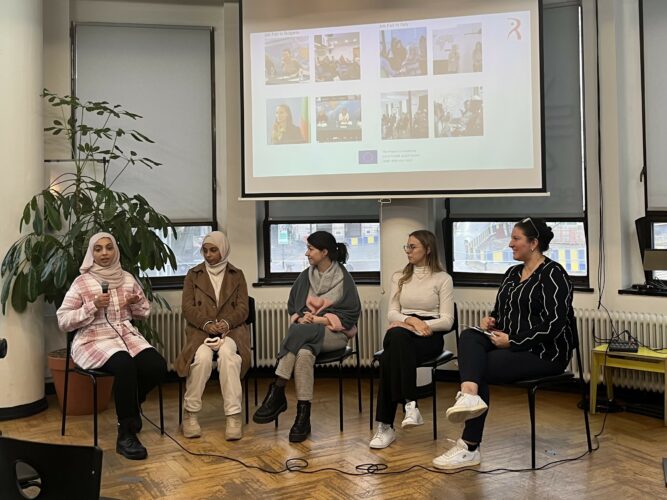
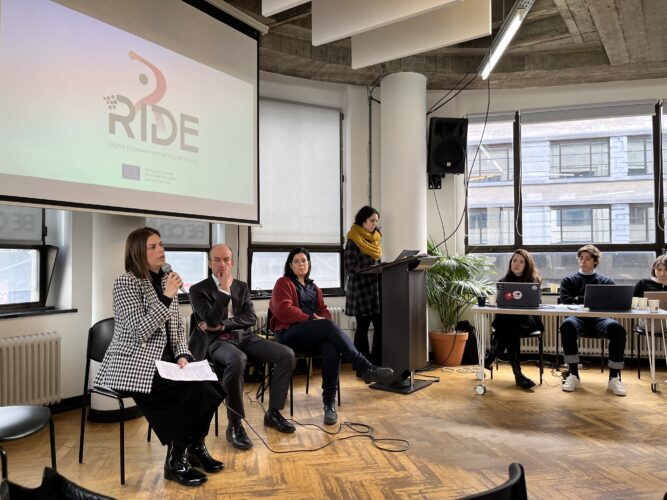
After running for two years, the RIDE project (Reach Inclusion Through Digital Empowerment For Migrant Women) concluded this month, with a closing event held in Brussels on 20 January 2023. Co-funded by the EU’s Asylum, Migration and Integration Fund (AMIF), the project aimed at advancing the inclusion of migrant and refugee women in the digital labour market by organising training, mentoring and job fairs in six EU countries. Project partners, trainees of the programme and policy-makers gathered for the event to discuss the outcomes, key takeaways, and future policy directions concerning the inclusion of migrant and refugee women in the digital labour market.

The RIDE project in numbers:

  • 400 hours of mentoring and coaching per country
  • 60 participants taking part in training by Cisco or The Code to Change
  • 6 Job Placement Fairs
  • 200+ migrant women attending Job Placement Fairs
  • 40+ companies attending Job Placement Fairs

The final event featured a forum discussion with the participation of the project partners: Diesis Network, UNITEE, European Network of Migrant Women, Code to Change, the Bulgarian Chamber of Commerce and Industry, Litus Novum, Symplexis, Legacoopsociali, and Youth Included, supported by the CISCO Networking Academy’s digital training programs for migrant women. During the full-day event, various discussions took place, including a panel discussion on the policies concerning migrant women and digital skills, titled “Exploring the policy landscape: the inclusion of migrant women in Europe’s digital economy”. Panelists included Tim Van Rie from the European Commission’s Directorate-General for Employment, Social Affairs & Inclusion, Ursula Hoenich from the Commission’s Directorate-General for Migration and Home Affairs, and Lina Konstantinopoulou from Eurochambers.

Throughout the day, a recurring theme mentioned by project partners and policy-makers was the need for personalised attention to the needs of this specific target group. A training programme that offers flexibility and empathy in adjusting the course to the needs of participants can lead to lower drop-out rates and a generally better experience for everyone, both participants and organisers. Courses that do not take the specific needs of migrant women into account, such as language barriers, cultural differences, and time restrictions, especially for mothers, might lead to preventing future involvement of migrant women in civil society initiatives altogether. Another interesting, recurring point was related to the RIDE project’s job fairs. According to a survey issued by the European Commission, over 70% of businesses reported the lack of staff with adequate digital skills. 

During the project implementation, companies and trainees participated in national job fairs for migrant women, which also showed the willingness of companies to adjust their offers to the needs of the migrant women. At the same time, partners pointed out that the companies needed guidance in recognising the best ways to accommodate the needs of migrant women, who do not present a homogeneous group and include a wide range of cultural backgrounds.

Moreover, Liane Adler from Litus Novum and Gabriela Dimitrova from the Bulgarian Chamber of Commerce and Industry reported that it had been easy to engage employers and get them to participate in the job fairs. Knowing the needs of both sides allowed Liane and Gabriela to create the best space and opportunity for employers and job seeking migrant women to meet and connect. By reaching out to migrant organisations and individuals through different channels, including social media, they were able to involve not only trainees from the RIDE programme but also migrant women that were new to RIDE. The overall outcome of the training, mentoring and job fairs was positive: several participants received a job or an internship offer, or could develop their network, skills and confidence. Indeed, just taking part in a job fair and sustaining an interview in a foreign language can be considered a great achievement, as Nora Giannakaki (Symplexis) highlighted.

One of the event highlights featured testimonials from RIDE trainees Alawia & Sara Sagaf Mashhor Alkaf from Bulgaria, Yulianti Kurnianingsih from Italy, and Valeriya Strekalovskaya from the Czech Republic. They each explained to the event participants how participating in the RIDE project and upskilling digitally empowered them to pursue new career goals.

Celebrating International Migrants Day with a webinar on Migrant Women & Digital Skills

To mark International Migrants Day, UNITEE and its partners from the RIDE project organised a webinar on Migrant Women and Digital Skills, which took place on Thursday, 15 December.

Over the last two years, the RIDE project has been piloting a wide range of training and mentoring methods to enable migrant women in Europe to find jobs in the digital sector. We believe giving migrant women digital skills is a successful way to include them in the labour market and the social fabric of their host society.  The digital transition is a key goal of the European Union, and Member States are walking the path of digitalisation in all sectors. Nonetheless, large sections of the population have  little to no digital skills which blocks them from benefiting from the opportunities that the digital economy sector offers. Migrant women and refugees suffer further impediments coming from gender discrimination and social exclusion. Thus, the RIDE project has been addressing these issues by delivering training courses along with mentorship and coaching sessions aimed at enabling migrant and refugee women to find a job in the digital sector and be part of the digital labour market.

The webinar was moderated by Vesa Latifi, project manager at Diesis, one of the widest networks supporting the development of social economy and social entrepreneurship, and co-leader with UNITEE of the RIDE project. Three experts working at the local, national and European levels brought their insights and experience on the topic of migrant women labour market integration and gender disparity in the digital sector: Iffat Gill (The Code to change), Liane Adler (Litus Novium) and Frohar Poya (European Network of Migrant Women). These organisations act in different countries and at different levels of the project. From digital skills training to coaching and mentoring, the speakers’ firsthand experience with the implementation of the project and the topic of integration of migrant women made the webinar an insightful moment of learning for all the participants. The speakers addressed the  challenges of integrating migrant women into Europe’s society and workforce and shared the  main takeaways and  recommendations learned through the course of the project.


Frohar Poya
is project officer at the European Network of Migrant women, a women-led platform that advocates for the rights of migrant, refugee and ethnic minority women in Europe. She shared the findings of a study report conducted in the framework of the project about the digital sector opportunities and barriers for migrant and refugee women.

There is still a gap between men and women when it comes to digital skills. In Europe 8 out of 10 ICT jobs go to men (only 17% of ICT specialists in Europe are women).  In some countries, this gap is considerably wider than in others. Among the countries involved in the RIDE project, Italy, Bulgaria, and Czech Republic are the ones who score worse. These gaps need to be acknowledged and addressed to facilitate migrant women’s access to a growing market and thus improving their level of integration in these societies.


Iffat Gill
is the founder and CEO of Amsterdam-based Code to Change, an association aimed at reducing the skills gap and associated gender divide in the tech sector. Code to Change has been successfully running trainings directed to empower women in the digital sector and reduce the existing gap that Frohar addressed while opening the webinar.

Migrant women are a very heterogeneous group, says Iffat, and there are no “one size fits all” solutions. Each programme is thus designed taking into account the specific needs of the group considered. This attention and care put into the design of the training programmes makes them so successful and fruitful.

Designing the training programmes encompasses several phases:

Stakeholder analysis: Making sure they are involved and engaged. From public & private companies to tech companies, stakeholders must be kept on board and also informed about the target group for better chances in future recruitments.

Skills mapping/country analysis:. Looking at the top skills demanded by the digital labour market in different countries is a key step for successful trainings.

Skills assessment:. Identifying the skills in high-demand is not enough for the  successful integration of the trainees in the labour market. These must be in line with the personal skills and interests of future employees.

Selection of digital skills program. Finally, a digital skills programme is selected and implemented, taking into consideration the elements above.


Liane Adler
is the founder and managing director of Litus Novum, a start-up based in Berlin that brings together jobseekers from abroad and employers from Germany through counselling, training and placement. Within RIDE, Liane leads the mentoring and coaching sessions. For integrating migrant women in the labour market upscaling their skills is not enough, a holistic and comprehensive approach is needed. Taking into consideration their motivation, needs and difficulties is a crucial step.

In her experience, the main challenges of the counseling and training sessions have been caused by the social-distancing measures of the pandemic, the consequent deterioration in the social and language progress of the trainees, and the lack of homogeneity within the groups, which pushed them to allocate more time to individual sessions. Indeed the group sessions proved to be effective as the students felt the group as a safe place to express themselves, their needs, and their concerns.

Webinars such as this have an important role in advancing the debate on the role of migrant women in the labour market and the gender gap in the tech sector. Migrant women’s involvement and active participation are  indispensable ingredients for a sustainable, fair and equitable digital economy and society.

Find out more about women’s participation in the digital economy and European initiatives here.

Rewatch the webinar here.

Empowering Youth with Lived Migration Experiences: Interview with Syrine Rekhis from Voicify

Policies that are co-designed together with migrants and refugees are still scarce. However, this issue has been receiving more and more attention in recent years, and there are many organisations and projects working towards more inclusivity in decision-making. Voicify is a recently founded umbrella organisation that aspires to promote inclusive decision-making and goes a step further by focusing on young migrants. Voicify trains and mentors youth advocates with lived migration experiences, empowering them politically and promoting their equal participation in policy-making processes.

Read our interview with Syrine Rekhis, President of Voicify, about the importance of their mission.

Follow our online magazine, The New European, for more.

Co-designing Policies: New Approaches Towards Inclusivity

What makes a city truly inclusive? How can it be assured that local policies are accommodating towards newcomers, refugees, and migrants and offer opportunities for them to participate? Co-designing policies can be the right approach to ensure that previously unheard voices are taken into account and consulted during the policy cycle.

Read our article about the advantages and challenges of co-designing policies, followed by a short interview with the city of Düsseldorf and their participation in the UNITES project.

Read the full article on our online magazine, the New European.

UNITEE at the European Business Summit 2022

speakers on the stage of the European Business Summit 2022

From 16-17 November 2022, UNITEE attended this year’s edition of the European Business Summit (EBS) that took place at the Egmont Palace in Brussels. The theme of the event was “Towards a greener, more integrated, and secure Union?”, exploring the twin transitions in light of recent economic instability.

The event featured panel discussions and interviews with policymakers and representatives of the private sector. The list of participants included 250 high-level speakers, such as Margarete Vestager, the European Commission’s Executive Vice-President for A Europe Fit for the Digital Age, Roberta Metsola, President of the European Parliament, Alexander de Croo, Prime Minister of Belgium, and Didier Reynders, EU Commissioner for Justice.

The mission of the annual European Business Summit is to promote a dialogue between EU decision-makers and businesses, showing how businesses can contribute to solving some of the pressing issues in contemporary Europe and beyond.

This year, much of the program focused on the green and digital transitions’ effects on the energy sector. In addition, some panel discussions featured the topic of SMEs and the ongoing challenges posed by the inflation and energy crisis.

See the full program and the recording of each session here.


Discussing European perspectives on migrant entrepreneurship at CREME’s annual conference

On 10 November, UNITEE, as a partner of the MILE project (Migrant Integration through Locally designed Experience) , joined the 26th Annual Conference of CREME (the Centre for Research in Ethnic Minority Entrepreneurship) to host a session on “European Perspectives on Migrant Entrepreneurship”.” CREME is one of MILE’s local partners in the UK, together with the Birmingham City Council and Ashley Community & Housing LTD, a service provide for migrants and refugees.

The session focused on the challenges and opportunities for the inclusion and growth of migrants and refugees through entrepreneurship, with the contribution of speakers from Madrid, Athens, Utrecht, and Amsterdam.

Dr. JuanFra Alvarado Valenzuela, researcher and educator in entrepreneurship at the University of Applied Sciences of Amsterdam, presented his key findings on the migrant entrepreneur community in the Dutch capital. Valenzuela brought interesting insights on several key topics related to migrant entrepreneurship, from the importance of family ties that often create transnational networks to the lack of role models for migrant entrepreneurs. Amsterdam represents a unique case due to its vibrant entrepreneurial culture and diversity. Diversity in migration, as Valenzuela highlighted, is often considered from the point of view of the country of origin, but it can be seen in many more indicators (e.g. place of residence, age or gender). For this reason, migrant and refugee entrepreneurs are themselves the “diverse group”, in comparison to the local context. 

When it comes to the integration of migrant entrepreneurs, one question that immediately comes up is: How does this diverse group interact with the local social fabric, especially the network of local entrepreneurs? The level of connection between them is uncertain but the situation has evolved in recent years. Gradually, local and migrant entrepreneurs seem to have established a certain degree of interaction, whereas just one or two decades ago they were worlds apart. 

The second speaker of the session was Dr Leendert de Bell, professor for sustainable labour participation of refugees at the Research Centre for Social Innovation (University of Applied Sciences Utrecht) and academic staff member at the Centre for Entrepreneurship (Utrecht University). De Bell has also been involved in the development and implementation of the entrepreneurship program at ‘Plan Einstein’, an initiative aiming to facilitate  the integration of refugees in Utrecht. 

Plan Einstein is a project which aims to connect residents of the Utrecht Asylum seekers centre and local communities. Within the project, various activities are organised for, by, and with migrants and refugees, in an effort to connect groups that often do not have a space and a chance to meet. Plan Einstein started in 2015 as a response to the growing number of refugees arriving in Europe. The project was launched, with the support of European funds UIA and ERDF in  2016.

One of the activities organised by the project are entrepreneurship courses, open to locals and refugees, to offer participants knowledge, contacts and skills to set up a business. In 3 years, over 200 participants took part in the training. Nevertheless, refugee and asylum seekers who approached the course had to overcome several obstacles related to the lack of knowledge of the specific local market, network, and access to finance. Many of the refugees also had no whatsoever experience related to business, as they were often employed in the public sector in their country of origin. However, these training proved to be an innovative and effective way to include newcomers and connect them with locals.

Meanwhile, Antonina Melody Casino, member of DIWATA (Determined Independent Women in Action for Total Advancement)  shared her experience as a migrant woman and  teacher at the Munting Nayon Cultural School in Athens, Greece. Munting Nayon is a multicultural school established by the female Filipino community back in 1994. Despite limited resources, it attempts to meet the needs of migrant parents working full-time. During its first years, Munting Nayon mostly welcomed children of Filipino migrants, but gradually evolved, becoming a multicultural school. Mr. Casino highlighted how initially their work was hampered by locals until being asked to shut down, but thanks to the support from privates and NGOs they were able to keep running.  Munting Nayon Cultural School, being an example of solidarity and social entrepreneurship, now welcomes children of migrants from Africa (Ghana, Nigeria, Kenya, Sierra Leone, Liberia, Ethiopia, Eritrea), Asia (Sri Lanka, Bangladesh, Pakistan, India, Philippines) and the Balkans (Albania, Bulgaria, Romania, Ukraine).  

Jennifer Riveiro Ilende closed the session by giving an overview of the situation of migrants in Spain. As a migration and immigration lawyer she is exposed daily to the struggles migrants face as they try to settle in Spain. From legalising their status to finding a job, newcomers are faced with many hardships.  Mr. Riveiro set up a law firm, ILENDE&Partners, to help migrants settle in Spain including by starting their businesses. 

Some of the obstacles migrants may face when starting a business are related to the high rate of taxation to which businesses are subject, bureaucracy and language barriers. The most vulnerable group of third country nationals in Spain is represented by North Africans; the procedures to have their status legalised, a prerequisite to start working and thus integrating, are very long and complex.

The stories and first-hand experiences of the four speakers complemented the insights shared during  the conference which included sessions looking at the value of ethnic minority entrepreneurship, diaspora entrepreneurs as international trailblazers and crisis and renewal in key sectors. CREME’s work and events such as these are crucial when advancing the debate on the role of migrant entrepreneurship in our societies. 

The RIDE Project’s Final Event is coming up on 20 January 2023 – Save the Date!

The RIDE project partners are delighted to invite you to Save The Date for the upcoming Final Event.

Time: 20 January 2023
Location: BeCentral, Cantersteen 10, 1000 Brussels

The event will be an occasion to bring together a wider community committed to supporting migrants in the area of digital skills and labour market integration and experiences of women, migrant and refugee, on their access to the digital labour market and possibilities for training and mentorship.

Register here

More details will follow soon – keep following RIDE project’s website and our social media channels for the latest information.

We look forward to welcoming you!

The RIDE team

CREME annual conference: Towards a New Agenda for Ethnic Minority Entrepreneurship

The Centre for Research in Ethnic Minority Entrepreneurship (CREME) is holding the 26th Annual Ethnic Minority Business Conference on Thursday 10th November 2022 from 10:00 – 16:45 GMT/UK time. Supported by Lloyds Banking Group the theme this year is: ‘Towards a New Agenda for Ethnic Minority Entrepreneurship’. This year’s Annual Ethnic Minority Business conference brings together leading researchers and examples from the world of business support to highlight how we can work together to promote our dynamic and vibrant entrepreneurial community that is genuinely open to all. The conference is hybrid, with capacity for delegates to attend in person at the University and online via Zoom.

For more information and to book your free spot online, please visit the event page.

As part of this year’s edition, UNITEE through its project MILE (Migrant Integration through Locally designed Experiences), is holding a session on “European perspectives on Migrant Entrepreneurship” with local insights from Madrid, Athens, Amsterdam and Utrecht on how entrepreneurship can become a tool to promote the inclusion and participation of migrants and refugees in Europe.

The speakers of this session are:

  • Dr JuanFra Alvarado Valenzuela, Senior Researcher & Educator in Entrepreneurship, Amsterdam University of Applied Sciences; specialised in entrepreneurship, social projects, migration trends, personal connections and cross-cultural bridging.
  • Antonina Melody Casino, member of DIWATA (Determined Independent Women in Action for Total Advancement) in Athens, Greece; teacher at Munting Nayon Cultural School, a school initially set up to support Filipino mothers, and now also other migrant communities, in accessing the labor market or running a business.

  • Dr Leendert de Bell, professor for sustainable labour participation of refugees at the Research Centre for Social Innovation (University of Applied Sciences Utrecht), academic staff member at the Centre for Entrepreneurship (Utrecht University) and involved the entrepreneurship program at ‘Plan Einstein’

  • Jennifer Riveiro Ilende, Spanish and Equatorial Guinean lawyer specialised in Immigration and Commercial Law; co-founder and managing partner at the law firm Ilende and Partners in Madrid, Spain

The full agenda of the conference:

Session 1: Grasping the Size of The Prize: The Value of Ethnic Minority Entrepreneurship and An Agenda for Change
Session 2: International Trailblazers – Recognising the Potential of Diaspora Entrepreneurs
Session 3: European Perspectives on Migrant Entrepreneurship
Session 4: Crisis and Renewal in Key Sectors
Session 5: Looking to the Future and Closing Reflections